
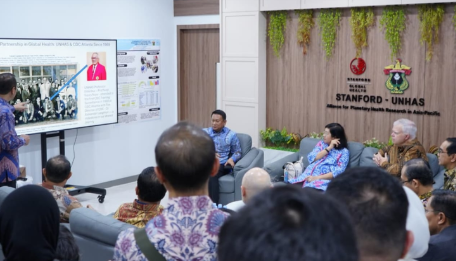
The Stanford US-Hasanuddin University (UNHAS) Center at the Tamalanrea Campus in Makassar served as the venue for a high-level forum on Saturday, 28 March 2026 aimed at deepening strategic cooperation with long-term global impacts. The collaboration primarily focuses on enhancing disease threat preparedness and strengthening public health systems to be more adaptive to global dynamics. In this framework, universities play a critical role as hubs for knowledge production, innovation, and the development of competent human resources.
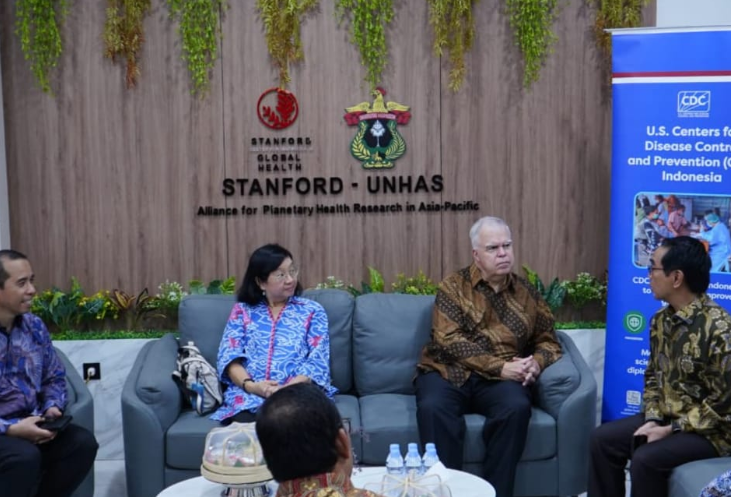
The Rector of UNHAS, Prof. Dr. Ir. Jamaluddin Jompa, M.Sc. (Prof. JJ), emphasized Planetary Health as a core pillar of future collaborations. This approach highlights the interconnections between human health, the environment, and sustainable development, requiring synergy across various disciplines and sectors. Under this framework, UNHAS acts as a bridge to integrate policy, research, and program implementation, specifically to bolster the contribution of Eastern Indonesia to the global health agenda.
“Through various strategic programs, UNHAS is committed to continuously optimizing its contribution,” explained Prof. JJ. The Rector also highlighted the urgent need to decentralize science and research development, which has historically been concentrated on the island of Java. He noted that strengthening international collaborations is a strategic move to expand the university’s role within the global academic ecosystem.
U.S. Ambassador H.E. Peter M. Haymond stated that this partnership has a clear trajectory with priority programs ready for immediate implementation. Support is directed toward result-oriented collaborations that ensure sustainability and long-term impact. “UNHAS has the capacity to be a catalyst that involves other universities. We see a great opportunity for UNHAS to lead collaborations and become a benchmark for academic research development in this region,” Ambassador Haymond remarked.
A key pillar of this initiative is the continued partnership with the U.S. Centers for Disease Control and Prevention (US CDC), particularly through the Field Epidemiology Training Program (FETP). This program has been instrumental in producing competent epidemiologists and strengthening public health response capacities in Indonesia. Furthermore, the collaboration includes the development of grant schemes to encourage partnerships between U.S. institutions and Indonesian universities, with UNHAS serving as the primary driver in expanding these collaborative networks to address national and global health challenges.