
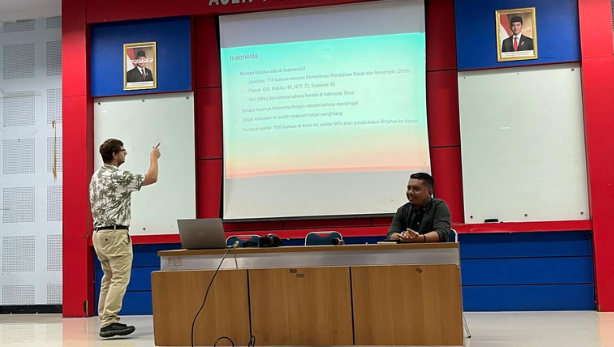
Concerns over the declining diversity of regional languages in Eastern Indonesia took centre stage during a public lecture held by the Faculty of Cultural Sciences (FIB) at Hasanuddin University (UNHAS). The event, hosted at the Prof. Mattulada Hall on Friday, 6 March 2026, brought together students, lecturers, and researchers to discuss one of the most pressing cultural challenges facing the region today. The lecture featured French linguistics expert Dr Daniel Krausse, who shared his research and observations on the gradual decline in the number of speakers of local languages across Indonesia, particularly in the eastern part of the archipelago.
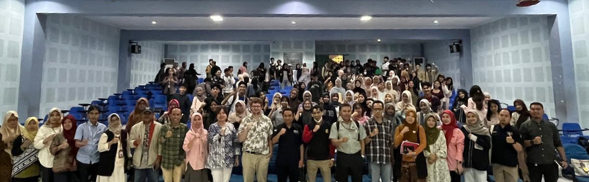
In his presentation, Dr Daniel highlighted the growing threat of language extinction and the alarming reduction in the number of speakers of many regional languages over the past few decades. Indonesia is internationally recognised as one of the most linguistically diverse countries in the world, with hundreds of languages spoken across its vast archipelago. However, according to Daniel, this remarkable diversity is increasingly under threat. He noted that although the richness of Indonesia’s linguistic heritage is widely celebrated, the reality on the ground reveals a troubling trend: many local languages are losing speakers, especially among younger generations.
Regarding the historical and social factors behind the decline, Dr Daniel explained that several elements have contributed to the weakening position of regional languages. One of the earliest influences was the widespread use of Bazaar Malay as a lingua franca in trade and interethnic communication. This form of Malay had already become a common medium of interaction long before the colonial period and continued to be used extensively during the era of Dutch rule. Another major factor is the national education system, where the Indonesian language dominates as the primary medium of instruction. While the promotion of Indonesian has played a vital role in building national unity, Daniel noted that it has also gradually reduced the use of local mother tongues in everyday communication, particularly in formal contexts. Equally significant is what Daniel described as a shift in the perception of modernity. Many young people today tend to associate regional languages with rural life or outdated traditions. In contrast, Indonesian and foreign languages are often viewed as symbols of modernity and as tools that offer greater economic opportunities and career mobility.
Despite these challenges, Dr Daniel emphasised the importance of balancing local and national identity, arguing that preserving regional languages does not mean rejecting the national language. Instead, he argued for a balanced perspective in which both linguistic identities can coexist. “Regional languages represent our original identity, while Indonesian reflects our national identity,” he told the audience. “There is no need to abandon one in order to embrace the other. Both can be preserved and valued at the same time.” He also encouraged students to take pride in their linguistic heritage and to continue using their mother tongues within families and communities as a way of safeguarding cultural continuity for future generations.
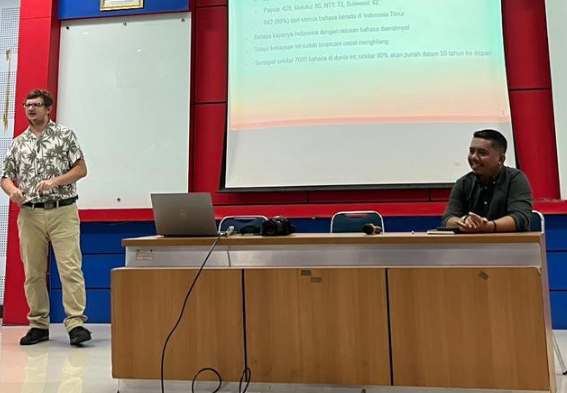
Regarding the historical and social factors behind the decline, Dr Daniel explained that several elements have contributed to the weakening position of regional languages. One of the earliest influences was the widespread use of Bazaar Malay as a lingua franca in trade and interethnic communication. This form of Malay had already become a common medium of interaction long before the colonial period and continued to be used extensively during the era of Dutch rule. Another major factor is the national education system, where the Indonesian language dominates as the primary medium of instruction. While the promotion of Indonesian has played a vital role in building national unity, Daniel noted that it has also gradually reduced the use of local mother tongues in everyday communication, particularly in formal contexts. Equally significant is what Daniel described as a shift in the perception of modernity. Many young people today tend to associate regional languages with rural life or outdated traditions. In contrast, Indonesian and foreign languages are often viewed as symbols of modernity and as tools that offer greater economic opportunities and career mobility.
Despite these challenges, Dr Daniel emphasised the importance of balancing local and national identity, arguing that preserving regional languages does not mean rejecting the national language. Instead, he argued for a balanced perspective in which both linguistic identities can coexist. “Regional languages represent our original identity, while Indonesian reflects our national identity,” he told the audience. “There is no need to abandon one in order to embrace the other. Both can be preserved and valued at the same time.” He also encouraged students to take pride in their linguistic heritage and to continue using their mother tongues within families and communities as a way of safeguarding cultural continuity for future generations.
The event also highlighted the importance of building bridges through international collaboration in addressing cultural and linguistic challenges. Dr Wahyudin, S.S., M.Hum., Vice Dean for Partnerships, Research, Innovation, and Alumni Affairs at FIB UNHAS, stated that inviting international scholars is part of the faculty’s broader strategy to enrich academic perspectives and expand research opportunities. According to him, the presence of experts such as Dr Daniel provides valuable insights for students and lecturers alike while opening the door to future partnerships. “We are committed to inviting scholars from around the world to share the latest developments in their fields,” Dr Wahyudin said. “Through events like this, we hope to encourage collaborative research between our lecturers and international researchers.” Such collaborations, he added, could play an important role in documenting, studying, and revitalising endangered languages in Indonesia.
The public lecture served not only as an academic forum but also as a reminder of the value of linguistic heritage. As Dr Daniel concluded in his talk, when a language disappears, humanity loses a unique way of understanding and interpreting the world. For students and academics at UNHAS, the discussion reinforced the urgency of protecting Indonesia’s rich linguistic heritage before more of its voices fall silent.